
Themost popular Italian pastasare always the same seven, whether in Rome, Madrid or New York. They are neither the rarest nor the most difficult: they are the ones that found their sauce and never let go. Here is the list, with the dish that suits each one and the mistake people keep making when ordering it.
| Pasta | Where it comes from | Its dish | The mistake |
|---|---|---|---|
| Spaghetti | Southern Italy | Carbonara, aglio e olio, vongole | Ordering it with Bolognese ragù |
| Tagliatelle | Emilia-Romagna | Bolognese ragù | Thinking it is fettuccine |
| Rigatoni | Rome and central-southern Italy | Oven-baked,amatriciana | Serving it with a sauce that is too thin |
| Gnocchi | Northern Italy | Butter and sage, tomato | Ordering it expecting pasta |
| Pappardelle | Tuscany | Game ragù, mushrooms and truffle | A sauce that cannot match its width |
| Paccheri | Campania | Neapolitan ragù,cacio e pepe | Confusing it with rigatoni |
| Filled pasta | All of Italy | Butter and sage, broth | A sauce that overwhelms the filling |
There is no official count of pasta shapes: many are regional and change names from one town to the next. For the full classification by shape, see our separate guide totypes of Italian pasta. Here, we look at the seven you will find on almost any menu.
Cylindrical, smooth and around two millimetres thick. Their smooth surface does not grip thick sauces, and that is their appeal: they shine with sauces emulsified with cooking water. Carbonara,aglio e olio,vongole. Three sauces with four ingredients each.
The mistake:ordering them with ragù. The meat slides off the strands and ends up at the bottom of the plate. Ragù belongs with tagliatelle, number two on this list.
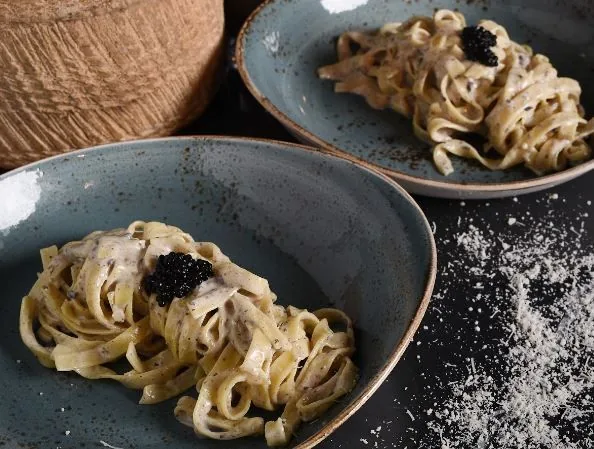
Flat egg pasta ribbons, six to eight millimetres wide, from Emilia-Romagna. Egg makes them porous, and a porous ribbon absorbs ragù instead of letting it fall off. That is why in Bologna ragù is served with tagliatelle, and “spaghetti Bolognese” does not exist.
The mistake:mistaking them for fettuccine. They are almost the same — egg pasta ribbons — but tagliatelle are northern and a little narrower, while fettuccine are Roman and wider.
Tubes with ridges on the outside. This shape has the most useful surface area on the list: the ridges grip sauce outside and the hollow holds it inside. It withstands oven cooking best, because a gratin needs something to support the cheese.
The mistake:pairing them with a thin sauce. With a light oil dressing or very loose tomato sauce, all those ridges catch nothing.
The great outsiders on the list:they are not pasta. Made from potato and flour in northern Italy, they cook in two or three minutes, until they rise to the surface. They share the pasta section on the menu and are eaten like pasta, but belong to another family.
Their classic sauce is as simple as it gets: butter and sage. They also work very well with tomato and fresh cheese, because they are mild and do not compete with other flavours.
The mistake:ordering them expecting the texture of pasta. They are tender and fluffy, which can surprise anyone who does not know.
The widest ribbons, two to three centimetres across, almost always fresh. This is the pasta of thetrattoriein Tuscany and the only one on the list that can handle a game ragù: wild boar, hare, or autumn mushrooms with butter.
The mistake:choosing a sauce that cannot match them. With ribbons this wide, a light sauce disappears; they need something substantial that clings.
Very wide, short tubes from Campania. Each piece is literally a container: it fills with sauce and is eaten in almost one bite. They are the pasta for slow-cooked Neapolitan ragù, and work just as well withcacio e pepe.
The mistake:confusing them with rigatoni. Rigatoni are narrow and ridged; paccheri are smooth and as wide as a thumb.
Here, the pasta is the wrapper and the filling is the dish. Square ravioli, ring-shaped tortellini,Fagottiniclosed like little bags, rolled cannelloni. Every Italian region has its own version and filling.
The mistake:drowning them in sauce. They are served with butter and sage, a light tomato sauce or broth, because a strong sauce masks the very reason you ordered the dish.
The seven mistakes in the table are really the same mistake repeated seven times:choosing the sauce without considering the pasta. The surface of each shape determines how much sauce it can hold, and all the classic pairings follow from this. There is much more behind this principle, which we explore shape by shape intypes of Italian pasta.
All seven feature on theÔVEN menu, each with its matching recipe:
We have nine restaurants with the same menu: eight in Madrid —Preciados, Gran Vía 6, Gran Vía 55, Fuencarral, Atocha, Prado, BernabéuandLas Tablas— and one inMurcia.
| Spaghetti | Long and smooth, made from semolina. Emulsified sauces |
| Tagliatelle | Porous egg pasta ribbons. The pasta for ragù |
| Rigatoni | Ridged tubes. Thick sauces and oven cooking |
| Gnocchi | Potato and flour, not pasta. Butter and sage, tomato |
| Pappardelle | Wide, fresh ribbons. Game ragù, mushrooms |
| Paccheri | Wide, smooth tubes. Neapolitan ragù,cacio e pepe |
| Filled pasta | The filling comes first. Butter, sage or broth |
| The rule | Rougher, hollow or wider → thicker sauce. Smoother and thinner → lighter sauce |
Spaghetti, in terms of consumption and recognition abroad. Within Italy, however, the answer changes with the map: Bologna will say tagliatelle, Rome rigatoni or bucatini, and Naples dried semolina pasta. There is no single national favourite; each region has its own.
Any of the seven, but with its matching sauce. For an easy choice, try tagliatelle with ragù or spaghetti with a well-made carbonara. These two best show what makes Italian pasta distinctive, because in both dishes the sauce depends on the pasta’s shape, rather than the other way round.
You can, and many places will serve it. But most traditional combinations are based on the physics of the dish, not just custom. A thick sauce slides off smooth pasta, while a light sauce has nothing to cling to inside a wide tube. Consistent pairings on an Italian menu are not a sign of inflexibility.
Short pasta and baked pasta. Gratinéed rigatoni or paccheri arrive intact because their thick walls keep them from overcooking on the way. Thin strands fare worst: they keep cooking in their own heat and tend to clump. If ordering long pasta, choose egg pasta ribbons covered in sauce rather than spaghetti with a loose sauce.
The balance matters more than the number. A short menu with the four or five main shapes and the right sauce for each is a better sign than a very long list where every dish has the same sauce and only the pasta shape changes.